The Olfactory Processing Unit (OPU)
We became frustrated with the current state of olfaction sensors as none of them are optimized for real-time robotics use cases such as scent-based navigation. So we built our own, optimizing the entire hardware and software engineering stack in the process.
Our custom-silicon OPUs are the heart of each device and enable entirely new capabilities for embodied intelligence.
The OPU automatically handles airflow, calibration, drift correction, and signal multiplexing. Our several APIs and AI models enable developers to build on top of our platform for their robotics applications.
Each OPU can be configured in a variety of form factors such as Sigma and Reconnaisscent, or chained together in true GPU fashion as with Scentinel.
Multiple patents granted and pending.

Reconnaisscent
Reconnaisscent is designed for rapid, sub-second chemical sensing in robotics applications at the edge. Slightly bigger than a bottle cap, Reconnaisscent contains a single olfactory processing unit (OPU) with the ability to detect 16 different (and programmable) chemical compounds along with temperature, barometric pressure, and humidity. Also on board the device is an IMU for better scent-based navigation through olfactory inertial odometry.
The Scentience APIs enable developers to communicate with the device over BLE, Wi-Fi, ethernet, I2C, SPI, and USB to stream live chemical data to their desired platform.
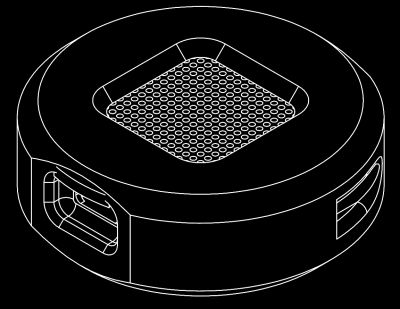

The small form-factor enables the device to be used on the lightest of UAVs, humanoid robots, and other edge devices to perform scent-based navigation. Navigation purely by scent is now real and repeatable, and we were the first to prove it.

Swarm intelligence enables many devices to be networked together to triangulate the source of chemical compounds within a building or robot training environment. Each device comes pre-installed with the necessary networking software.
Sigma
The Sigma multimodal data collection instrument gives anyone training multimodal AI & robotics models the ability to collect time-synchronized vision, chemistry, audio, and inertial data. By integrating right into iOS and Android devices, the instrument works with embedded OVLMs in the Scentience app to collect high-signal ego-centric datasets en masse.
The most common third party olfactory sensors along with Scentience proprietary sensors are available in interchangeable adaptors. Sigma is configured to adapt to any smartphone or tablet.
With the deployments in nearly a dozen countries, nobody is gathering more real-world olfaction data for robotics and world models than Scentience.


Sigma nterfaces with the most common third party chemical sensors along with our own effectors designed for rapid multi-spectral detection time-synchronized with vision, lidar, audio, and IMU data.
Each OPU can be rapidly fit with different sensor arrays to match the exact chemistry of your target environment. Track dozens of compounds at once or only the handful you need.
Scentinel
Scentinel is designed for more qualitative analysis of air samples for comprehensive chemical composition. With higher chemical resolution (part-per-trillion) than its Reconnaisscent counterpart, Scentinel houses 8 OPUs for the detection of hundreds of chemical compounds. Onboard multimodal AI works with the Scentience App to perform long-context chemical analysis.
Machine olfaction lags behind other sensory modalities partially due to the lack of large training datasets. To solve this, Scentinel was designed to operate in laboratory settings for the acquisition of mass amounts of training data for multimodal AI models.

Scentinel was designed to acquire mass amounts of multimodal training data for AI foundation models at research institutions. The device operates with the same seamless APIs and AI models as Reconnaisscent.
Field tests with Scentinel have been performed within botanical and aerospace environments to infer results in long-context chemical patterns that can inform safety, air quality, and business decisions. Data is accessed via Scentience dashboard or mobile app..
ODK-1: Olfactory Development Kit
To encourage progress in machine olfaction for robotics, Scentience offers an olfactory development kit that is equipped with multiple chemical sensors. Each ODK-1 is equipped with the foundational code and AI models to communicate with the Scentience App and APIs, and is intended for research purposes only.
ODK-1 is available for order today. Purchasing researchers are requested to give feedback on their honest experience to help advance olfaction for AI, robotics, and science. Purchasers of the ODK-1 must consent to the research agreement.
